

Yes, reading to newborns is worth starting in the first weeks of life. Your voice, not the words on the page, does the heavy lifting: the American Academy of Pediatrics recommends shared reading from birth, and infants read consistently show higher language scores by 9 to 12 months. A few minutes a day, following your baby’s cues, is the whole assignment.
TL;DR:
- Reading to newborns at least seven times a week significantly boosts language development scores by 9 to 12 months, with more frequent reading leading to greater gains.
- Interaction, responsiveness, and shared voice are the crucial elements; the actual book is less important than engaging respondively during reading.
- Start reading immediately after birth, attaching short sessions to routines like feeding or diaper changes to build consistency without added effort.
- Stage-specific behavior influences book choice: high-contrast images for newborns, rhythmic and textured books for older infants, and keeping sessions short and lively.
- Incorporating sensory toys and prompts can extend and enrich reading interactions without requiring lengthy or formal reading sessions.
Table of Contents
- Reading to Newborns Benefits: What the Research Actually Shows
- When to Start Reading to a Newborn and How Often
- What to Expect at Each Stage: Birth Through 12 Months
- How to Read to a Baby: Techniques That Make a Few Minutes Count
- Which Books Work Best for Newborns
- How Nurture-neuroscience’s Tools Extend Shared Reading
- A Caregiver’s View: Reading Doesn’t Have to Look Perfect
- Ready-Made Ways to Build a Reading Routine
- Sources
- FAQ
Reading to Newborns Benefits: What the Research Actually Shows
The evidence on reading to infants is more specific than “it’s good for them.” A study published in the Journal of the American Board of Family Medicine found that infants who were read to at least seven times a week had measurably higher expressive and receptive language scores at both 9 and 12 months compared with babies read to less often, and the difference was statistically significant. That’s not a soft correlation. It’s a dose pattern, more reading, more language gain, tracked over the first year.
The AAP frames shared reading as more than a literacy tool. Its policy guidance treats it as a relationship-building practice that supports attachment and social-emotional growth alongside cognitive development, which is why pediatricians now bring it up at well-baby visits the same way they discuss sleep or feeding. Cleveland Clinic’s overview groups the payoff into five areas: language development, bonding, emotional learning, routines, and later school readiness.
Three things reading builds at once:
- Language exposure. Repeated words and rhythmic sentences prime the brain’s auditory processing before a baby ever babbles a syllable.
- Attachment. Being held close, hearing a familiar voice, and making eye contact during reading reinforces the same bonding pathways as feeding or soothing.
- Predictable routine. A short book before a nap or at bedtime gives an infant’s nervous system a reliable cue that calm is coming.
One caveat worth naming honestly: the benefit doesn’t come from books as objects. It comes from the interaction. A parent narrating a walk around the living room delivers a similar language boost to a board book, because the active ingredient is responsive, voice, warmth, and turn-taking, not the printed page itself.
When to Start Reading to a Newborn and How Often
Start now. Literally, in the hospital or the first days home, your newborn’s hearing is already tuned enough to recognize your voice and find it calming. There’s no developmental gate to unlock first. HealthyChildren.org, the AAP’s parent-facing resource, puts it plainly: it’s never too early.
Frequency matters more than duration. The seven-books-a-week threshold from the JABFM study isn’t a strict quota to hit or fail. It’s a signal that consistency compounds. A two-minute session tucked into a diaper change or a feeding pause, done daily, adds up to more language exposure over a month than one long, guilt-driven Sunday reading marathon.
The easiest way to hit that consistency without turning it into another task on your list is to attach reading to something you’re already doing. Read one board book before a nap. Narrate a few lines during a feed. Keep a book by the changing table for thirty seconds of rhyme while you work. None of this requires a set-aside “reading time” block, which is genuinely good news for anyone running on newborn sleep.
What to Expect at Each Stage: Birth Through 12 Months
Your baby’s reaction to books changes fast over the first year, and knowing what’s typical at each stage keeps expectations realistic instead of discouraging.
- Birth to 3 months. Attention spans are brief, but newborns respond to voice tone and simple faces. High-contrast black-and-white images hold focus longer than pastel illustrations because a newborn’s visual system hasn’t developed full color discrimination yet. Reading now often works as much as a soothing tool as a learning one.
- 3 to 6 months. Focus improves and babbling starts to overlap with your reading voice, an early form of vocal turn-taking. This is a good window to introduce board books with strong rhythm and rhyme, since infants at this stage respond noticeably to sing-song cadence.
- 6 to 9 months. Mouthing and grasping take over. Expect books to get chewed, batted, and dropped more than “read” in any traditional sense. Textured pages and books with flaps or crinkle elements hold attention because touch is now a primary way your baby explores.
- 9 to 12 months. Pointing and imitation emerge. Babies start reaching toward pictures, patting the page, or trying to mimic a sound you make. This is the beginning of genuine back-and-forth interaction around a book, not just passive listening.
None of these stages are a hard deadline. Babies move through them at different paces, and a baby who’s still mouthing books at 10 months instead of pointing is not behind, just on their own timeline.
How to Read to a Baby: Techniques That Make a Few Minutes Count
Reading to an infant isn’t about performance. Early-childhood specialists describe it as “serve-and-return”, a back-and-forth exchange where you respond to your baby’s sounds, kicks, or gaze the way you’d respond in a conversation. That framing changes how a session actually goes.
- Pause and respond. When your baby coos, squirms, or looks away, pause instead of plowing through the page. That pause is the interaction, not a delay in it.
- Exaggerate your voice. Shifting pitch, slowing down for rhymes, and using distinct voices for characters keeps a newborn’s attention far longer than flat, monotone reading.
- Repeat without guilt. If your baby wants the same three pages every night, that repetition is doing real work. Familiar rhythm helps infants anticipate words, an early building block of language processing.
- Keep it short. A two to five minute session that ends before your baby gets fussy beats a ten minute session that ends in tears. Follow their lead on when to stop.
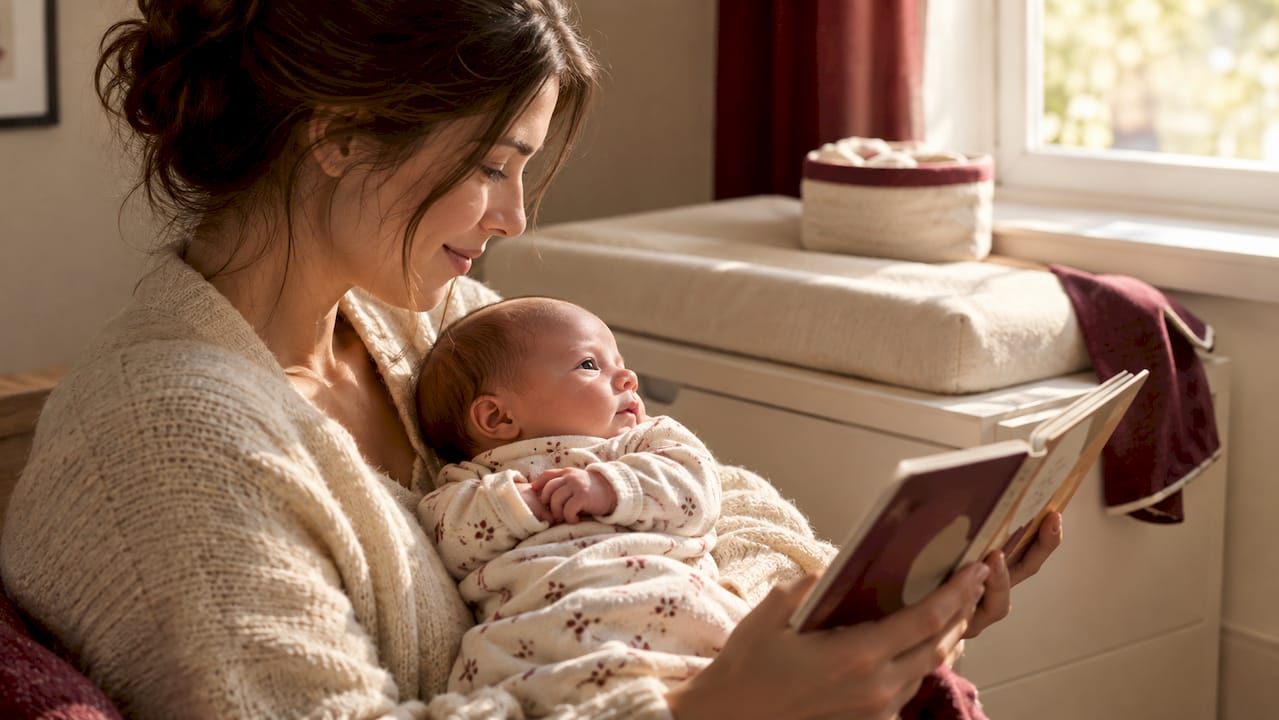
- Position for contact. Hold your baby so they can see your face and the page at once, skin-to-skin or in a supported cradle hold works well in the newborn weeks.
Pro Tip: If your newborn seems more interested in your face than the book, close the book. Making faces and narrating what you see is still shared reading in every sense that matters.
Which Books Work Best for Newborns
Book choice matters less than consistency, but some formats genuinely work better for a young infant’s developing senses. High-contrast black-and-white books are the strongest early pick because newborns see sharp contrast well before they see color detail, a fact reflected in why so many newborn nurseries display bold graphic mobiles instead of soft pastels.
- Books with rhymes and repetition support language patterning even before a baby understands a single word.
- Board, cloth, and vinyl books survive the mouthing phase that starts around 4 to 6 months and hold up to drool and chewing.
- Touch-and-feel or flap books become engaging once grasping skills develop, usually past 6 months.
- Household items count too. A cereal box, a magazine, a photo of grandparents, all of these give your voice something to narrate.
A quick safety note: check that pages and covers are wipeable and made from non-toxic materials, since almost everything ends up in a baby’s mouth eventually. Cloth books that machine wash are a practical choice for the early months when spit-up is a constant companion.
How Nurture-neuroscience’s Tools Extend Shared Reading
This brand is founded on the premise that early development tools should follow evidence, not milestone pressure. Its products are designed around the principle that responsive interaction, not passive exposure, drives growth.
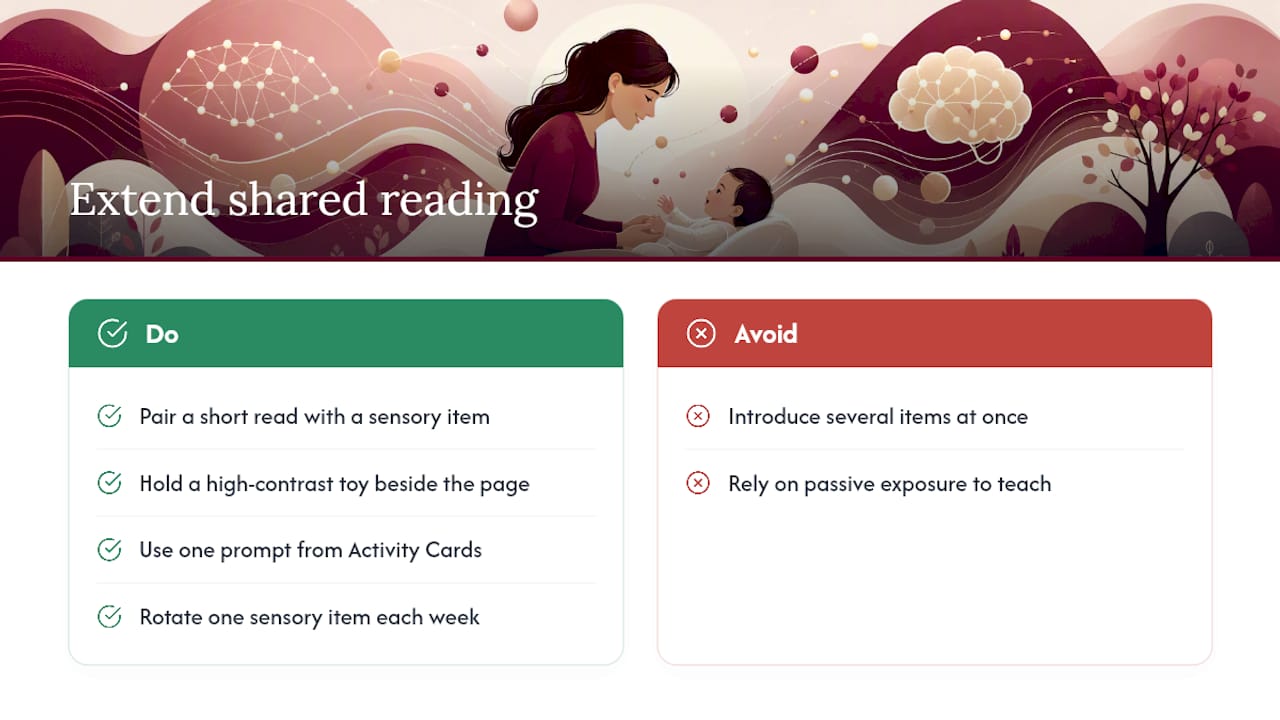
Pairing a short read with a complementary sensory item can stretch a two-minute session into a richer moment. Hold a high-contrast sensory toy beside a board book page so your newborn’s gaze has somewhere to land between your face and the print. A single prompt from the Baby Discoverers Activity Cards can turn a familiar bedtime book into a slightly different game each night, keeping an older infant’s attention without changing the routine itself.
Pro Tip: Rotate one sensory item into your reading nook each week instead of introducing several at once. A newborn’s attention is limited, and fewer choices usually means longer, calmer focus.
A Caregiver’s View: Reading Doesn’t Have to Look Perfect
Some nights your reading session lasts ninety seconds before your baby cries for a feed, and that’s still shared reading. Grandparents, partners, and other caregivers can all read the same three board books on rotation. Consistency across people matters more than any one person doing it flawlessly.
— Cory
Ready-Made Ways to Build a Reading Routine
If you want tools that make shared reading easier to sustain rather than another thing to plan around, Nurture-neuroscience designs its products specifically for that gap between what pediatricians recommend and what tired parents can actually manage.

The New Baby Connection Set ($20) pairs naturally with a lap read in the newborn weeks, giving your baby a bonding-focused item to hold or watch while you narrate a board book aloud. For caregivers who want to extend attention past the first few months, the Baby Discoverers Activity Cards ($20) offer short, stage-based prompts you can slot in right after a story, so reading time flows into a few minutes of guided play instead of ending abruptly. The High-Contrast Sensory Toy ($20) suits the earliest weeks best, when your newborn’s visual system responds far more to bold black-and-white patterns than to picture-book illustrations. These products are built on developmental research, so you’re not guessing which item matches your baby’s stage.
Browse the full collection to find the set that fits your baby’s current stage, and start pairing it with tonight’s bedtime book.
Sources
- Shared reading recommendation / policy summary (AAP-related research)
- Parental reading to infants improves language (JABFM study)
- Healthychildren
- Reading to babies — KidsHealth
- 5 benefits of reading to babies and little kids — Cleveland Clinic
FAQ
Is Reading to a Newborn Actually Beneficial?
Yes. Consistent reading is linked to higher language scores by 9 to 12 months, and the AAP recommends it from birth to support both language and attachment.
When Can I Start Reading to My Newborn?
You can start in the first days of life. Newborns already respond to voice and tone, and HealthyChildren.org states plainly that it’s never too early to begin.
What Is the 5-3-3 Rule for Babies?
This isn’t a recognized pediatric or developmental guideline referenced in shared reading research, and definitions of it vary widely online. Stick to the guidance that is well supported instead: short, daily reading sessions with responsive interaction, following your baby’s cues rather than a fixed rule.
What Are Signs of High IQ in Babies?
There’s no reliable early-infancy checklist that predicts IQ, and claims suggesting otherwise go beyond what the research supports. What the evidence does show is that consistent language exposure, including regular reading, correlates with stronger language scores in the first year, which is a meaningful outcome on its own without needing to frame it as an IQ marker.
Do I Need Special Baby Books to Start Reading to My Newborn?
No. Your voice and responsive interaction, not the book itself, drive the benefit, so narrating anything nearby works in the earliest weeks. High-contrast books and board books become more useful as your baby’s vision and grasping skills develop past the first few months.