

The most effective newborn play is short, responsive interaction with a caregiver: face-to-face talk, singing, tummy-to-tummy time, and high-contrast visuals held close. There’s no gear required and no schedule to master. Keep sessions brief, repeat them during your baby’s alert windows, and always follow safe-sleep rules once playtime ends.
TL;DR:
- Short, responsive interactions like face-to-face talk and tummy-to-tummy time are most effective and require no equipment or strict schedule.
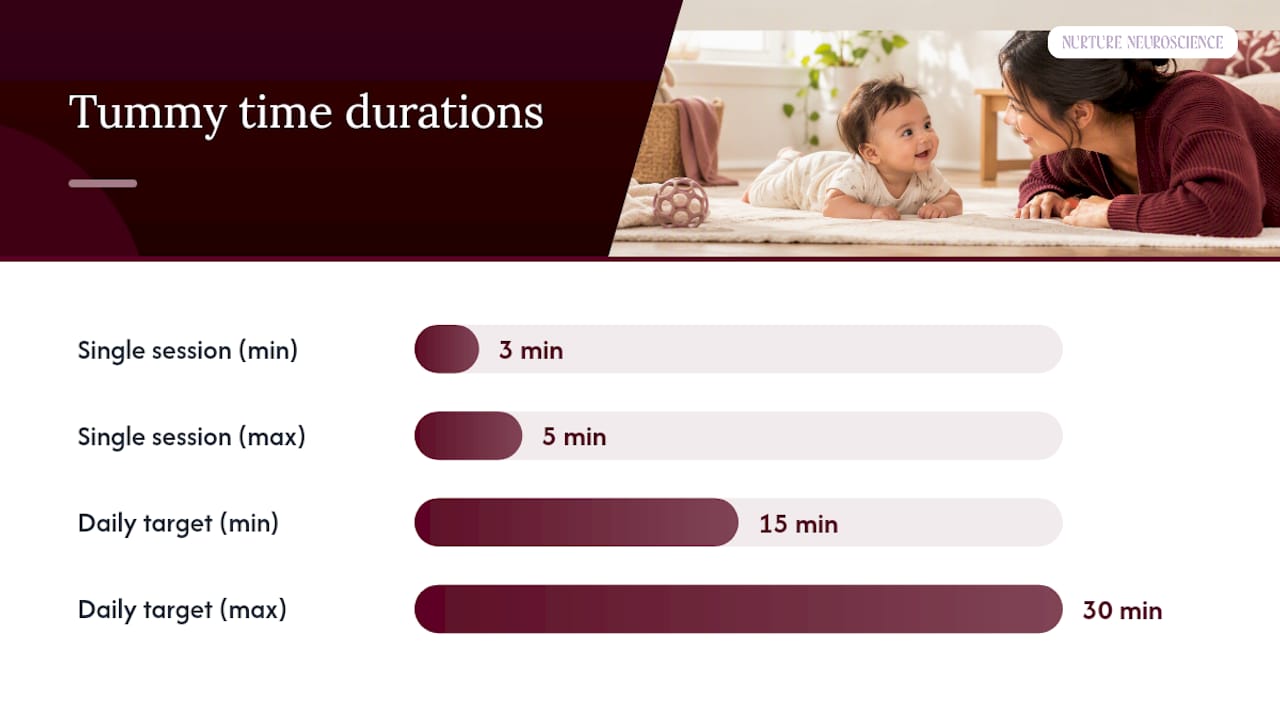
- Supervised tummy time should start with 3 to 5 minute sessions and gradually increase to 15 to 30 minutes daily by around seven weeks.
- Visual play should focus on high-contrast patterns within 20 to 30 centimeters from the baby’s face, avoiding busy or electronic toys.
- Using simple, real faces and everyday objects during narrated routines and face games is more engaging for newborns than elaborate toys.
- Caregivers should prioritize consistent, brief micro-sessions over extended playtime to build bonding, communication, and neural connections.
Table of Contents
- Why Newborn Play Ideas Matter More Than Milestone Checklists
- Safe Sleep vs. Tummy Time: What Canadian Guidelines Say
- Sensory and Visual Play Ideas Newborns Can Actually See
- Movement Play: Tummy Time Variations That Build Strength
- Social and Language Play: Voices, Songs, and Face Games
- Five Micro-Sessions to Try Today
- How LovedFully’s Screen-Free Tools Map to These Activities
- A Reality Check for Exhausted New Parents
- Start With One Ready-Made Newborn Play Kit
- Where This Guidance Comes From
- Sources
- FAQ
Why Newborn Play Ideas Matter More Than Milestone Checklists
Play in the first three months isn’t about flashcards or early achievement. It’s about wiring the systems your baby will use for a lifetime of connection and communication. Every time you respond to your newborn’s gaze, cry, or coo, you’re reinforcing the foundation of secure attachment, the sense that the world responds to them.
That responsiveness does double duty. It builds bonding and it builds language, because narrating your actions, singing, and waiting for your baby’s turn to “reply” with a coo or a look is how early communication takes shape.
- Bonding: You are your newborn’s first and most important playmate, more engaging than any gadget.
- Language: Talking, singing, and pausing for a response teaches turn-taking before words exist.
- Sensory wiring: Short, repeated sensory experiences, a face, a voice, a pattern, help build early neural circuits.
Skip the pressure to hit milestones on a schedule. Newborn development runs on connection and repetition, not a countdown.
Safe Sleep vs. Tummy Time: What Canadian Guidelines Say
Canadian public health guidance is built around a simple phrase: back to sleep, tummy to play. Your baby goes on their back for every single sleep, and tummy time happens only while they’re awake and you’re watching, according to Health Canada’s safe sleep guidance. This isn’t a suggestion. Back sleeping is one of the strongest tools for reducing the risk of sudden infant death, and it’s confirmed in the Joint Statement on Safe Sleep.
How to introduce tummy time:
- Start chest to chest, reclined on your body, so your newborn feels your warmth and heartbeat.
- Move to lap-based tummy time once they tolerate the chest position.
- Try short floor sessions, 3 to 5 minutes, a few times a day.
- Build gradually, aiming for a total of 15 to 30 minutes daily by around seven weeks, a progression Healthychildren recommends.
Statistic to remember: Supervised tummy time two to three times daily, in short bursts, is the frequency the joint Canadian safe sleep statement points to for building neck and shoulder strength safely.
Safety checklist: stay within arm’s reach, keep the sleep space free of soft bedding, and if your baby falls asleep mid-tummy time, move them to the crib on their back immediately. Rotate which direction their head faces in the crib each night. It’s a small habit that helps prevent flat spots without cutting into awake tummy time. Watch for early rolling attempts, that’s your cue to stop swaddling for sleep.
Sensory and Visual Play Ideas Newborns Can Actually See
Newborn vision is blurry and short range. Babies focus best on objects 20 to 30 centimeters away, roughly 8 to 12 inches, about the distance from your baby’s face to yours when you’re holding them. Keep every visual activity inside that zone.
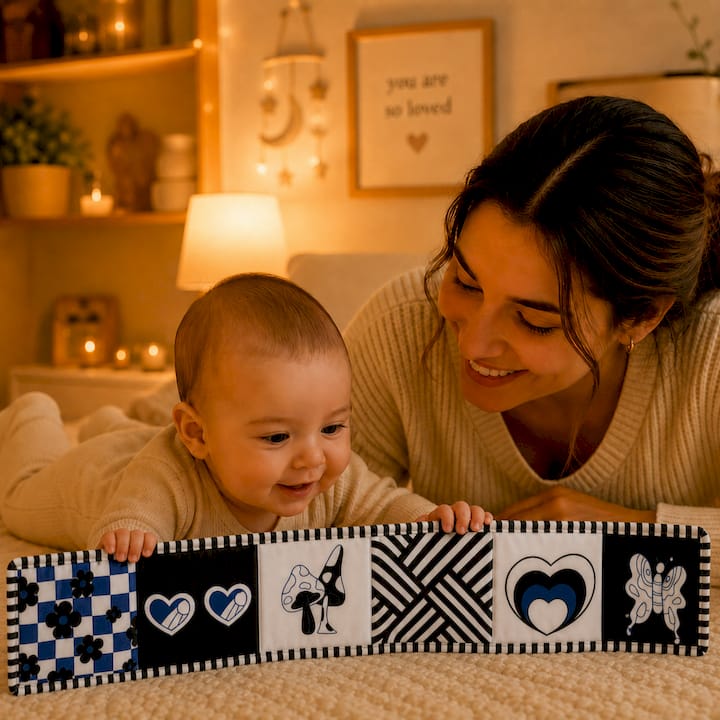
- Hold high-contrast cards or black-and-white patterns at that distance and let your baby’s eyes settle before moving.
- Use an unbreakable baby mirror during tummy time for a self-directed peekaboo moment.
- Offer textured fabrics, a soft muslin cloth, a ribbon edge, for gentle touch exploration.
- Try household items safely: a wooden spoon wrapped in cloth, or a laundry item for a quick peekaboo game.
Move slowly, repeat the same visual a few times across the day, and narrate what you’re doing (“I’m holding this close so you can see it”).
Pro Tip: Newborns often prefer simple, real faces and everyday objects over busy or electronic toys, so don’t feel like you need to buy anything elaborate to keep them engaged.
Movement Play: Tummy Time Variations That Build Strength
Not every baby tolerates the floor right away, and that’s normal. Progress through positions rather than forcing one.
- Begin with tummy-to-tummy contact while you’re reclined, the most secure starting point for a newborn who resists the floor.
- Try lap-based tummy time, draping your baby over your legs while you sit.
- Add supported side-lying, using a rolled towel behind their back if needed.
- Once they tolerate short floor sessions, add gentle bicycle legs or hold a toy just out of reach to encourage head-lifting.
Start at 3 to 5 minutes and build from there. Progress matters more than pace.
Social and Language Play: Voices, Songs, and Face Games
Your face and voice are the most sophisticated toys your newborn has access to.
- Make exaggerated expressions, wide eyes, an open mouth, and mirror back any sound your baby makes.
- Sing short, rhythmic phrases during diaper changes or feeds. Melody holds attention longer than plain speech.
- Narrate routine actions in short sentences: “Now I’m lifting your legs. Here comes the wipe.”
- Pause after you speak or sing and wait. That gap is where your baby practices their first “turns” in conversation.
None of this requires props. It requires proximity and attention, which is exactly what early language development runs on.
Five Micro-Sessions to Try Today
Newborn play ideas work best when they attach to something you’re already doing. Try these:
- After a diaper change: 60 to 90 seconds of face-to-face talk, no toys, just your voice and expression.
- Post-feed, still upright: Tummy-to-tummy contact while your baby digests.
- On the changing table: A quick vocal call-and-response game, wait for a coo, then echo it back.
- Before a nap: A one-line lullaby paired with a peek in a safe mirror.
- During a stroller walk: Ongoing narration, “we’re passing the mailbox,” keeps language flowing even outside.
Each session runs under two minutes. Stop the moment you see fussiness, gaze aversion, or sleepy eyes. Flexibility beats a fixed routine every time.
How LovedFully’s Screen-Free Tools Map to These Activities
LovedFully was founded by Dr. Greer Kirshenbaum, a neuroscientist and infant mental health expert who built the brand around one idea: responsive interaction outperforms structured curriculum, especially in the newborn window. Every product is designed to support the categories above, not replace the caregiver doing them.
- The High-Contrast Sensory Toy gives you a ready-made visual tool sized for the 20 to 30 centimeter focus range covered earlier.
- Baby Discoverers Activity Cards turn the micro-session ideas into simple, scripted prompts you can grab one-handed.
- The New Baby Connection Set bundles starter activities and caregiver prompts for parents who want structure without screens.
Screen-free, low-tech tools consistently outperform electronic “educational” toys for newborn engagement, a pattern reflected in Canadian screen time guidance for children under two.
A Reality Check for Exhausted New Parents
You don’t need a curriculum. Three sixty-second sessions of real eye contact will do more for your newborn than one long, forced “playtime” you both dread. Pick one micro-session from this list and try it three times today, then pass the safe-sleep rules on to anyone else caring for your baby. Stay curious about what your baby responds to instead of chasing a checklist.
— LovedFully
Start With One Ready-Made Newborn Play Kit
LovedFully turns the science in this article into physical tools you don’t have to build from scratch. The New Baby Connection Set bundles starter activities and caregiver prompts for the first weeks home, a practical option for exhausted parents or anyone shopping for a meaningful baby gift.
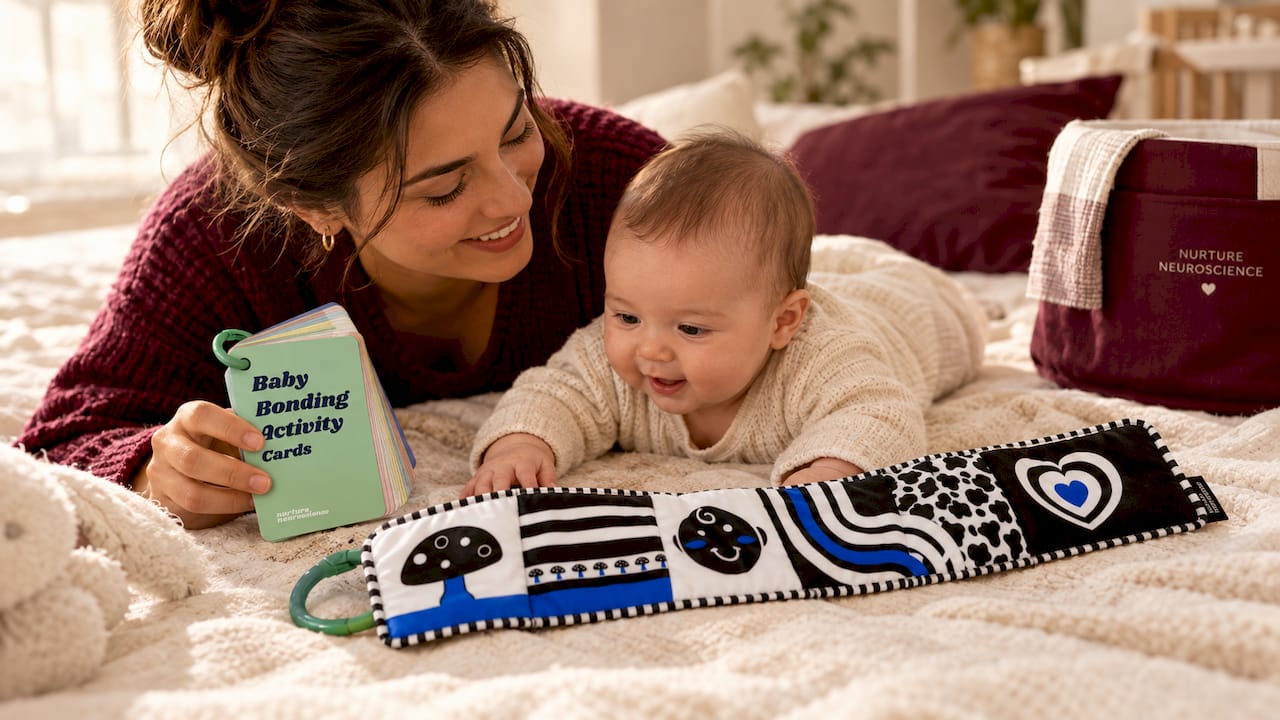
The Baby Discoverers Activity Cards turn the micro-session ideas from this guide into a physical deck you can pull out one-handed during a diaper change, priced at $20.00. The High-Contrast Sensory Toy, also $20.00, is built for the 20 to 30 centimeter visual range newborns actually see. Busy parents get structure without screens; caregivers and grandparents get a guided way to bond without guesswork. Keep any toy out of the sleep space and supervise every session. Browse the full collection of newborn kits to find the set that fits your family.
Where This Guidance Comes From
- The Canadian Paediatric Society’s playtime guidance supports the case for simple, everyday objects over electronic toys.
- Healthychildren informs the timing and progression steps above.
This article is general information, not a substitute for advice from a qualified doctor. Consult a qualified healthcare professional about your own circumstances before acting on anything here.
Sources
FAQ
What can I do to play with my newborn?
Talk face-to-face, sing short songs, hold high-contrast patterns 20 to 30 centimeters from their face, and try tummy-to-tummy time while reclined. Newborn play works best as brief, repeated moments rather than long structured sessions.
What is the 3-3-3 rule for newborns?
This isn’t an official medical guideline, and definitions vary depending on the source, so treat any version you see online with caution. If you’re looking for structured newborn guidance, the evidence-backed standard to follow is back to sleep, tummy to play from Health Canada.
What are some fun activities for a newborn baby?
Face games with exaggerated expressions, peekaboo with a soft unbreakable mirror, tummy-to-tummy time, and narrated diaper changes all count as engaging newborn activities at home. LovedFully’s High-Contrast Sensory Toy is built specifically for the visual range newborns can focus on.
How long should tummy time sessions last?
Start with 3 to 5 minutes several times a day, building toward a daily total of 15 to 30 minutes by around seven weeks, according to HealthyChildren.org. Always supervise, and stop if your baby shows distress.
Are electronic toys better than simple sensory play for newborns?
No. Canadian public health guidance states there’s no evidence electronic toys marketed as educational help babies learn, and caregiver interaction remains more effective, per Canada.ca’s screen time guidance. Screen-free tools like activity cards and high-contrast toys align better with how newborns actually engage.