

Most babies move through a predictable sequence: cooing, then babbling, then first words, then short phrases, though the timing varies more than baby books suggest. The single most important thing you can do at every stage is talk with your baby, not at them, using face-to-face, back-and-forth exchanges. If specific red flags show up (covered below), a conversation with your pediatrician is the right next step.
TL;DR:
- Babies should show gestures like pointing or waving by 12 months, and a lack of these could indicate a delay needing professional assessment.
- Repeating and expanding on your child’s babbling, such as turning “ba” into “big ball,” can help build their vocabulary before they speak.
- Using live, variable singing and face-to-face interactions in daily routines has been linked to larger expressive vocabularies later on.
- Most children start combining two words around 18 to 24 months, with comprehension often exceeding expressive speech by a factor of two.
- Bilingual children develop language skills normally, but evaluations should consider both languages to accurately assess their progress.
Table of Contents
- Language Development in Babies: Birth to 3 Months
- Baby Speech Milestones at 4 to 6 Months
- What Happens With Language Between 7 and 12 Months?
- Toddler Talking Stages: 12 to 24 Months
- How to Support Early Language Skills Every Day
- When Should You Talk to a Doctor About Language Delays?
- The Neuroscience Behind Age-Appropriate Language Activities
- Connection Over Milestone Pressure
- Tools That Make Early Language Practice Easier
- Sources
- FAQ
Language Development in Babies: Birth to 3 Months
At this stage, language development is mostly about connection, not words. Your baby is learning that sound has meaning and that communication goes two ways, long before a single syllable comes out clearly.
Watch for these signs during everyday routines like feeding, diaper changes, and bath time:
- Calms or turns toward your voice, especially a familiar one
- Coos and makes soft vowel sounds, often when content
- Smiles socially in response to your face, not just reflexively
- Uses different cries for hunger, discomfort, or overstimulation, which you’ll start to recognize
Two simple practices go a long way here. Get face-to-face during feeding or diaper changes and narrate what you’re doing in a warm, exaggerated tone. When your baby coos, pause and imitate the sound back. That small imitation is already a conversational turn, and Mayo Clinic’s speech milestone guidance places cooing squarely in this window as an early, expected sound.
Baby Speech Milestones at 4 to 6 Months
Babbling starts here, and it’s louder and more varied than the cooing stage. Your baby is essentially rehearsing the mechanics of speech, testing consonant and vowel combinations well before any of them mean something.
Typical behaviors at this stage include:
- Vocal play: squealing, growling, blowing raspberries
- Varied babbling sounds like “ba,” “da,” or “ga,” sometimes strung together
- Turning eyes or head toward new or interesting sounds
- Laughing out loud during play
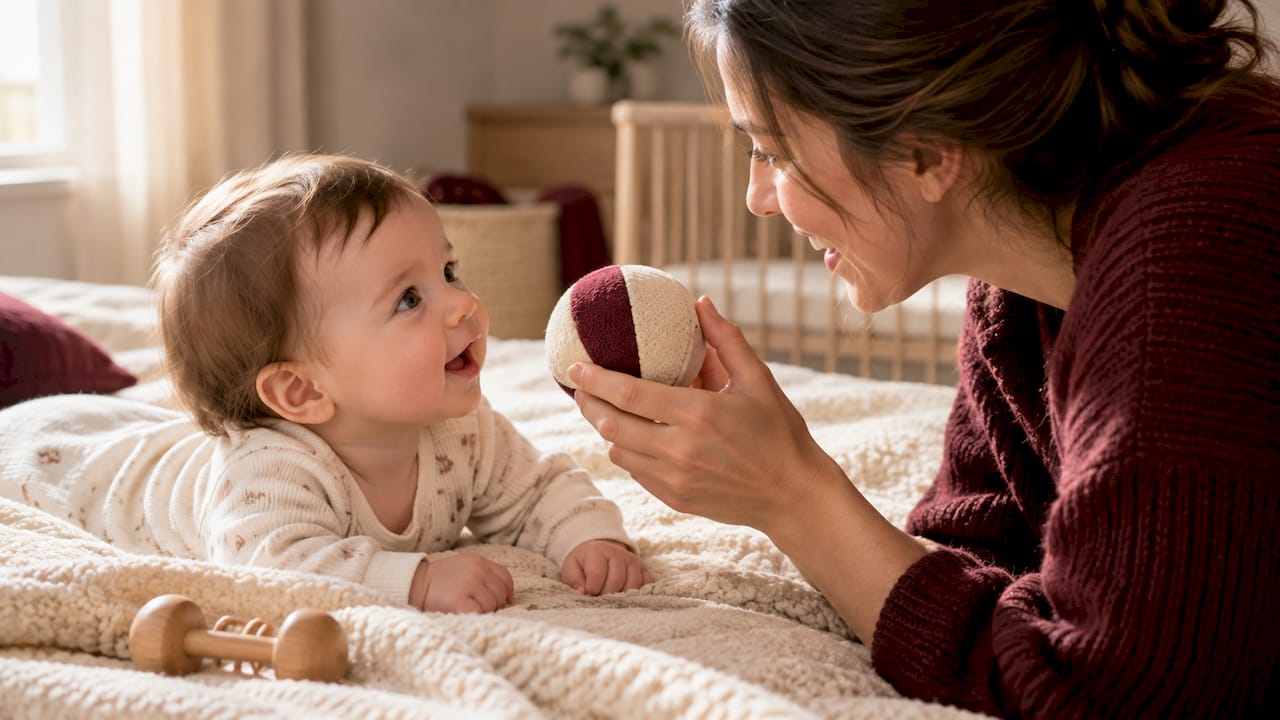
This is prime territory for parentese, the exaggerated, slower, higher-pitched speech pattern that isn’t the same as generic “baby talk.” Parentese uses real words with clearer vowel sounds and a musical cadence, and research out of the University of Washington links parent coaching in parentese to more conversational turns and larger vocabularies later on. Imitate your baby’s babbling, then add a new sound on top of it.
Pro Tip: If your baby babbles “ba ba,” repeat it back, then add “ba ba, ball!” while holding up a ball. You’re scaffolding a real word onto a sound they already produced on their own.
What Happens With Language Between 7 and 12 Months?
Gestures show up before words do, and that sequence matters. Pointing, waving, and reaching are your baby’s first intentional communication tools, and they usually predate a recognizable first word by weeks or months.
By the end of this window, expect:
- Pointing at objects, waving bye-bye, or lifting arms to be picked up
- Jargon: long strings of babble that sound like sentences with real intonation
- Imitating sounds, gestures, or simple actions you model
- One or two recognizable words, often “mama,” “dada,” or a pet’s name, close to the 12-month mark
Ritualized language, meaning the same songs, phrases, and routines repeated daily, gives your baby a framework for predicting what comes next. That predictability is part of what makes routines like bath time or bedtime such reliable language-building moments. When your baby points at something, name it immediately and simply: “Dog! Big dog.” You’re pairing a gesture with a word at the exact moment attention is highest.
Toddler Talking Stages: 12 to 24 Months
Vocabulary growth accelerates fast in the second year, and it rarely looks linear. Many toddlers hit a plateau, then a noticeable burst.
By 24 months, most children have around 50 words in their spoken vocabulary and start combining two words together, like “more milk” or “go car,” according to the National Institute on Deafness and Other Communication Disorders. Comprehension almost always runs ahead of speech. A toddler who says ten words might understand a hundred.
By the Numbers: Around 50 spoken words and early two-word combinations by age 2 is the typical benchmark public-health sources use, though the range of normal is wide.
A few things to keep in mind at this stage:
- Daily routines like grocery shopping, cooking, or laundry are language-rich if you narrate them out loud
- Bilingual or multilingual exposure is developmentally normal and is not a cause of delay on its own
- If concerns come up in a bilingual home, ask that any evaluation assess both languages, since a child’s total vocabulary across languages often looks different from either language alone
How to Support Early Language Skills Every Day
You don’t need a curriculum. You need short, repeated moments of real interaction, and the research on what actually moves the needle is fairly consistent.
- Talk in parentese and leave room for turns. Narrate diaper changes, walks, and mealtimes, then pause after you speak so your baby can vocalize back. That pause is what turns a monologue into a conversation.
- Sing live, and vary it. Live singing appears to matter more than passive recordings. A 2026 study in Nature found that live, variable “playsongs” are associated with larger expressive vocabularies later on, likely because live singing gives infants richer rhythmic and prosodic cues to track than a speaker ever can. Newborns already show early neural sensitivity to rhythm, which may help explain why musical interaction scaffolds language so effectively.
- Read interactively, not passively. Point at pictures, name objects, and ask questions even before your baby can answer. Simple gestures or baby sign language can bridge meaning before spoken words arrive.
- Limit passive screen time for children under two. The CDC’s Milestone Moments guidance recommends prioritizing responsive, face-to-face interaction over screens at this age, since a screen can’t respond to a baby’s gaze, sound, or gesture the way you can.
Pro Tip: Try “expansion”: when your baby says one word, repeat it back with one more word attached. “Ball” becomes “Big ball!” You’re modeling the next step without correcting or pressuring them.
When Should You Talk to a Doctor About Language Delays?
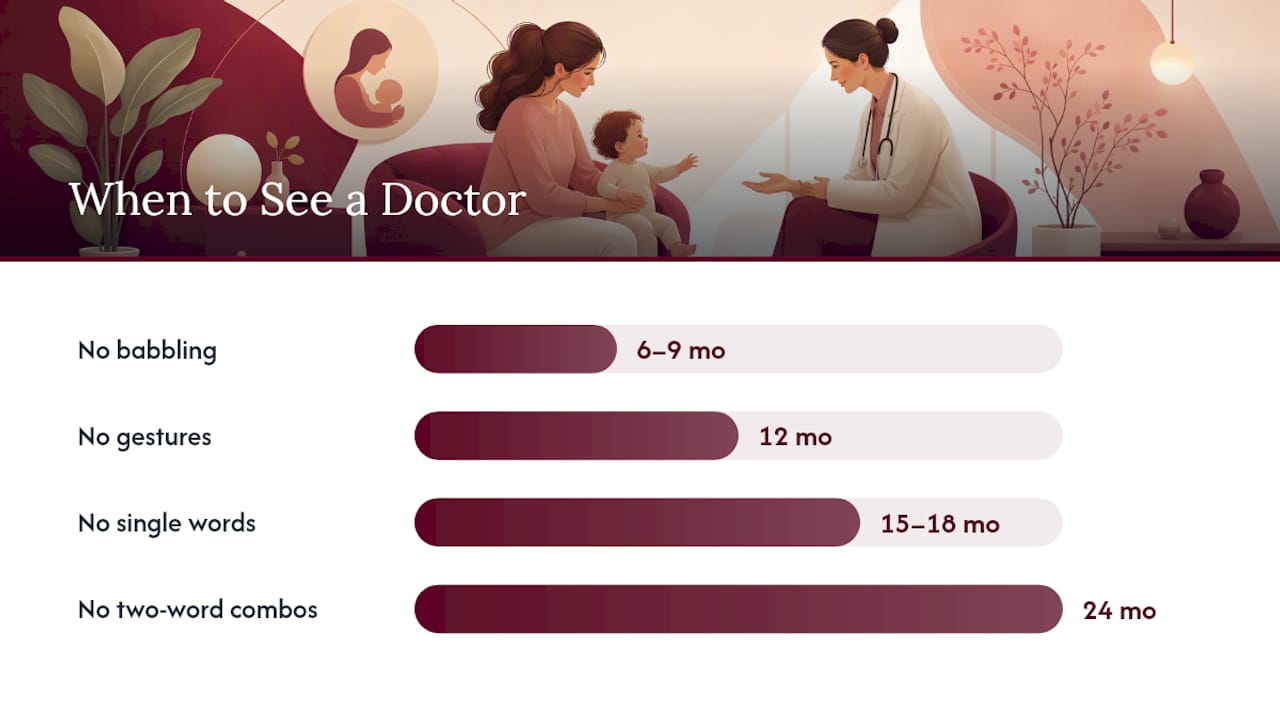
Milestones are guides, not deadlines, but certain gaps are worth a direct conversation with your pediatrician rather than a wait-and-see approach.
Contact your pediatrician or a speech-language pathologist if you notice:
- No babbling by 6 to 9 months
- No gestures, like pointing or waving, by 12 months
- No single words by 15 to 18 months
- No two-word combinations by 24 months
These signs don’t automatically mean something is wrong. A referral usually starts with a hearing screening, since even mild, undetected hearing loss can quietly slow language acquisition, followed by a developmental evaluation to rule out conditions like developmental language disorder or, in some cases, autism spectrum traits that affect early communication. Bring a short list of words your baby uses, notes on gestures they make, and any family history of speech or hearing issues. Early intervention, when needed, often starts with simple, play-based coaching for parents rather than anything clinical or intensive.
The Neuroscience Behind Age-Appropriate Language Activities
A neuroscientist and infant mental health expert translates early brain development research into activities families can actually use. That background shapes why the brand’s tools are built around attention, interaction, and word learning rather than passive entertainment.
The mechanics are straightforward once you see them:
- High-contrast visuals capture and hold a newborn’s limited visual attention, creating more opportunities for joint focus between baby and caregiver
- Activity cards give caregivers ready-made prompts for naming, turn-taking, and gesture play at each developmental stage
- Structured, caregiver-guided play builds the same responsive back-and-forth that parentese research links to stronger later vocabulary
Connection Over Milestone Pressure
Milestone charts are useful maps, not report cards, and most of the variation you’ll see between babies is completely normal. Treat every activity in this guide as a way to connect with your baby, not a task to complete on schedule. The guide is meant to flex with your child, not the other way around.
— Cory
Tools That Make Early Language Practice Easier
Screen-free, stage-matched tools can help caregivers focus activities on specific developmental goals rather than guesswork about what actually helps.
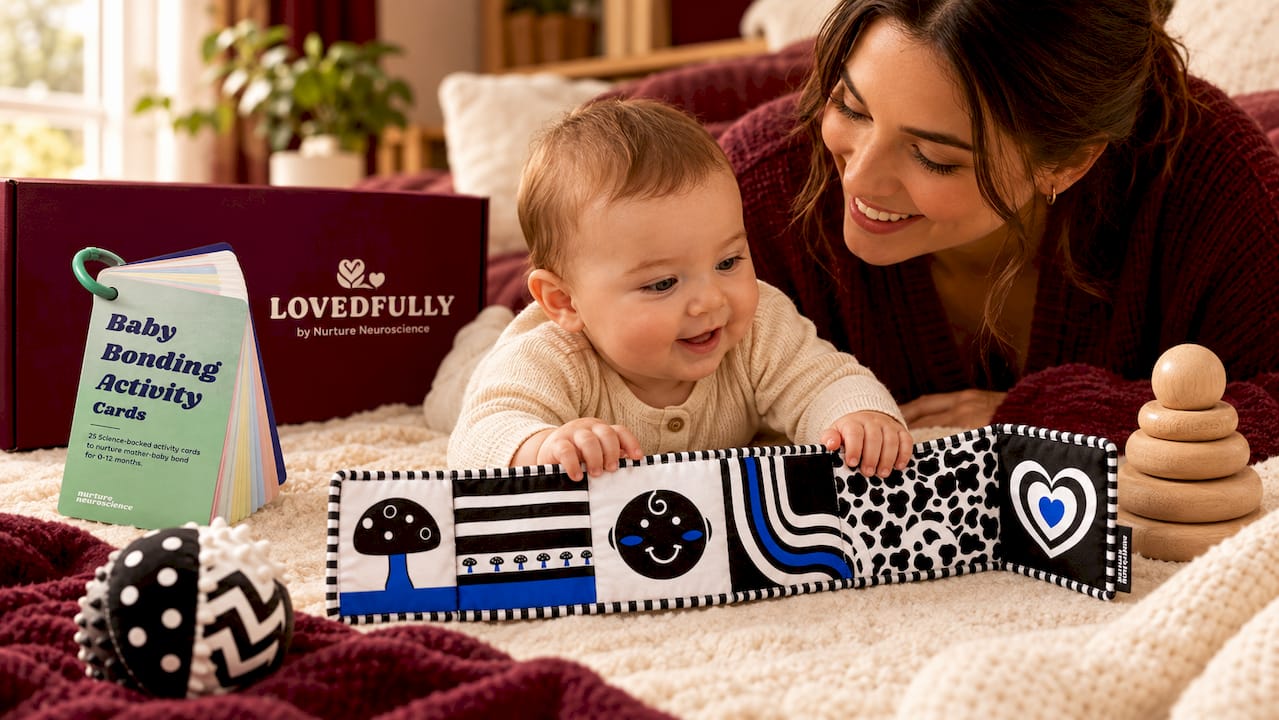
For the 0 to 3 month window, the New Baby Connection Set is built around the face-to-face, high-contrast interaction that supports early social engagement and visual tracking. Once your baby moves into the babbling and vocal-play stage, the High-Contrast Sensory Toy keeps that visual attention going, giving you more shared moments to narrate and name. And for caregivers who want structured prompts across the entire first year, the Baby Discoverers Activity Cards lay out specific, age-matched activities so you’re never guessing what to try next. Browse the full product collection to find the right set for your baby’s current stage, and always supervise playtime with sensory toys and small parts.
This article is general information, not a substitute for advice from a qualified doctor. Consult a qualified healthcare professional about your own circumstances before acting on anything here.
Sources
- Speech and Language | NIDCD
- Milestone Moments Booklet | CDC
- Language development: Speech milestones for babies | Mayo Clinic
- Not just ‘baby talk’: Parentese helps parents, babies make ‘conversation’ and boosts language development | UW News
- Music and infant brain development (2026) | Nature
FAQ
What Age Do Babies Typically Develop Language?
Cooing usually starts by 2 to 3 months, babbling by 4 to 6 months, and first recognizable words close to 12 months, according to Mayo Clinic. By 24 months, most toddlers have around 50 words and begin combining two words.
What Are the Red Flags for Language Development in Babies?
Key signs to watch for include no babbling by 6 to 9 months, no gestures like pointing by 12 months, no single words by 15 to 18 months, and no two-word phrases by 24 months. Any of these warrants a conversation with your pediatrician, per NIDCD guidance.
Is It Normal for a 2.5-Year-Old to Not Talk?
It’s not typical for a child this age to have no spoken words at all, and it’s worth a prompt evaluation rather than waiting further. Public-health sources recommend early assessment, including a hearing screening, since catching delays sooner generally leads to better outcomes.
Should a 1.5-Year-Old Be Talking?
Yes, most 18-month-olds have at least a handful of clear words and are actively adding more. If your toddler has no single words by 15 to 18 months, that falls on the NIDCD’s red-flag list and is worth discussing with your pediatrician.
Does Bilingual Exposure Delay Language Development?
No, growing up with two or more languages is developmentally normal and doesn’t cause delays on its own. If concerns do arise, ask for an evaluation that assesses your child’s abilities across both languages rather than just one.