

You bond with your newborn through repeated, responsive caregiving, not one perfect moment. The core loop is simple: notice a cue, respond warmly, then pause for your baby’s reaction. Skin-to-skin contact, face-to-face talk, and calm, attentive feeding and soothing all build this connection over time.
TL;DR:
- Bonding relies on repeated, responsive interactions like eye contact, talking, and touch, rather than a single perfect moment or milestone.
- Prompt and warm responses to newborn cues, especially timing responses during face-to-face exchanges, support the development of secure attachment patterns.
- Daily routines such as feeding, diaper changes, and tummy time serve as natural opportunities for meaningful, face-to-face interactions that reinforce bonding.
- Partners strengthen their bond by taking on specific caregiving routines like diapering or feeding, rather than helping informally or sporadically.
- Slow or delayed bonding is common and improved by consistent routines, support, and focusing on short, high-quality exchanges rather than longer, less engaged interactions.
Table of Contents
- What Bonding With a Newborn Actually Means
- Why the First Months of Bonding Matter So Much
- What Bonding Looks Like at 0 to 3 Months
- Your Daily Bonding Checklist: What to Do Today
- If Bonding Doesn’t Happen Right Away
- How Partners and Other Caregivers Can Build Their Own Bond
- Folding Bonding Into Feeding, Diapering, and Daily Chores
- The Science Behind These Bonding Practices
- A Note From LovedFully
- Simple Tools That Support Newborn Connection
- Sources
- FAQ
What Bonding With a Newborn Actually Means
Bonding is the felt sense of warmth and connection a parent develops toward a baby, often building fast through touch, smell, and gaze. Attachment is different: it’s the baby’s own developing expectation, built over months, that a caregiver will reliably show up when needed. Bonding is your side of the relationship. Attachment is theirs, and it grows from your consistency.
Every time you respond to a cry, meet a gaze, or soothe a fuss, your baby’s brain logs the pattern. Repeated across weeks, these small exchanges become a working expectation: someone comes when I need them. Canadian public-health guidance describes this as built through talking, singing, playing, cuddling, and responsive attention during ordinary caregiving, not through any single milestone or bonding session. Understanding this distinction matters because it takes the pressure off any one interaction and puts the focus where the science actually points: on repetition.
Why the First Months of Bonding Matter So Much
Responsive caregiving in the newborn window does concrete work for your baby’s developing nervous system. When a parent consistently notices distress and responds, the baby’s stress response gets practice regulating down instead of staying elevated. That practice shows up in easier feeding, since a calm baby latches and sucks more effectively, and in smoother sleep transitions, since a baby who trusts a caregiver’s presence settles faster after waking.
Research on face-to-face communication shows that the timing of a caregiver’s response, not just its presence, predicts later attachment patterns. A response that arrives promptly and matches the baby’s cue teaches the nervous system something specific: this world responds to me. Practically, that means a soothing routine doesn’t need to be elaborate. It needs to be prompt, warm, and consistent enough that your baby starts to anticipate it.
What Bonding Looks Like at 0 to 3 Months
Newborns communicate readiness for connection long before they can smile on cue or hold a rattle. Watch for these signals during alert, calm stretches:
- Locking eyes with you and holding the gaze for a few seconds
- Cooing, grunting, or soft vocal sounds directed at your face
- A relaxed body, open hands, and slow, even breathing
- Turning their head toward your voice or a familiar sound
- Briefly mimicking an open mouth or wide eyes after you make the expression
Your job is to answer these signals, not force new ones. Smiling back, softly repeating a sound your baby made, or gently stroking a cheek all count as bonding in the moment they happen. According to Raising Children Network guidance, the most useful skill is reading when your baby wants more (relaxed, engaged) versus when they’ve had enough (turning away, fussing, arching). Respecting that “enough” signal is just as important as responding to the “more” one. Expect wide variation here. Some newborns hold eye contact at two weeks; others take two months. Neither is a red flag.
Your Daily Bonding Checklist: What to Do Today
The single most reliable bonding tool is a predictable loop you can run during almost any task: notice the cue, name the need out loud, meet it, then pause to let your baby respond. A simple script sounds like this: “You’re rooting around, are you hungry? Let’s get you fed,” followed by feeding, then a few quiet seconds of eye contact before you move on. That pause is where the connection actually registers.
Here’s how to prioritize your time and energy across the day:
- Skin-to-skin contact whenever you can manage it. The World Health Organization recommends prolonged skin-to-skin contact when clinically appropriate, noting it supports warmth, feeding, and regulation alongside bonding. If immediate contact after birth wasn’t possible, later holding still works.
- Turn feeding into an interaction, not just a task. Whether you’re breastfeeding or bottle-feeding, hold your baby close enough for eye contact, talk softly, and notice when they pause or disengage. Public-health guidance is clear that feeding method doesn’t determine bonding; closeness, smell, and responsive attention do.
- Talk and sing during ordinary moments. Newborns respond to the rhythm and pitch of a familiar voice long before they understand words. Narrate what you’re doing: “Now I’m going to lift your arm.”
- Add short, supervised tummy time with your face close by. A minute or two, done while your baby is alert and you’re right there talking, builds both connection and early muscle strength.
- Use micro-moments most parents skip. Diaper changes, burping, and even fussy stretches are chances to narrate calmly, make eye contact, and return to steady breathing after a cry. These “unpleasant” tasks build as much trust as playtime does.
- Protect a calm night routine. You don’t need a long ritual. A dim room, a soft voice, and the same sequence of steps each night (change, feed, hold, put down) helps your baby predict what comes next, which lowers stress for both of you.
Pro Tip: Short, responsive interactions beat long, structured ones every time at this age. A 90-second exchange where you notice a cue and respond well does more for bonding than 20 minutes of an activity your baby has already checked out of. Watch for the “enough” signal and stop there.
If Bonding Doesn’t Happen Right Away
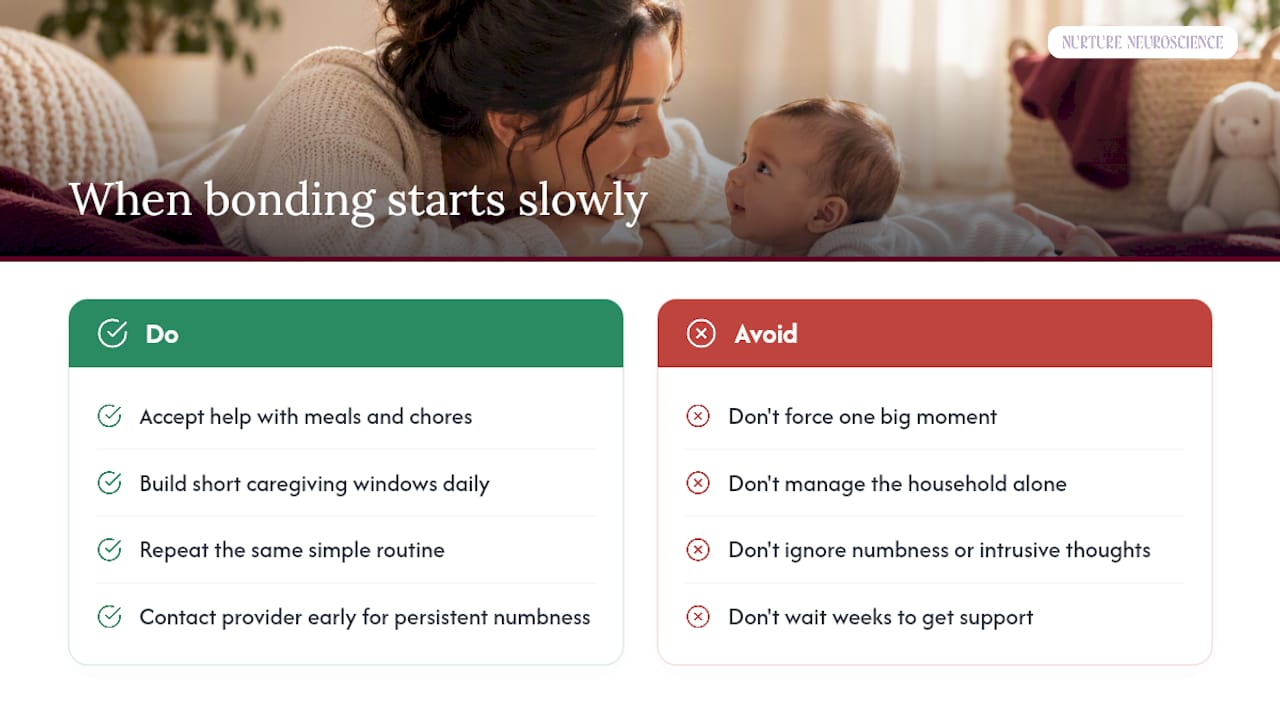
A slow start to bonding is common, and it is not a verdict on your relationship with your baby. MedlinePlus notes that bonding may unfold over minutes, days, or weeks, and it often takes longer after a difficult birth, a NICU stay, or medical separation from your baby. Exhaustion and perinatal mood disorders slow it further, and neither is a personal failing.
The practical fix starts small. Accept help with meals, chores, and errands so your energy goes toward holding and responding to your baby instead of managing a household. Build a few short, low-pressure caregiving windows into your day rather than trying to force one big connective moment. Repeat the same simple routine for feeding or settling; predictability does real work here.
Contact a health care provider or perinatal mental health service if you feel persistently numb, anxious, or disconnected past the first couple of weeks, or if intrusive thoughts appear. Earlier support shortens the gap.
How Partners and Other Caregivers Can Build Their Own Bond
Partners sometimes wait for bonding to happen automatically, especially when a nursing parent has an early physical head start. It doesn’t work that way. Bonding strengthens fastest when a partner owns specific, repeated caregiving routines rather than helping occasionally on the side.
Claim a few of these as your own:
- The first morning wake-up and diaper change
- Bath time, start to finish
- One feed a day, even if it’s a bottle of expressed milk
- Bedtime settling, including rocking or babywearing in a sling
- Burping and calming after feeds, paired with quiet talking or reading aloud
Avoid measuring your closeness against the other parent’s. Bonding isn’t a competition over who soothes faster. It’s built through your own repeated windows of one-on-one time. Tools like the Parent-to-Be Connection Set can help both partners talk through these role divisions before the baby arrives.
Folding Bonding Into Feeding, Diapering, and Daily Chores
Bonding doesn’t require carved-out extra time. It happens inside tasks you’re already doing. Narrate a diaper change (“I’m wiping now, all done in a second”) instead of rushing through it silently. Turn bath time into a slow, warm exchange with soft talking and steady eye contact. During feeds, notice the moment your baby’s sucking slows and pause instead of pushing through.
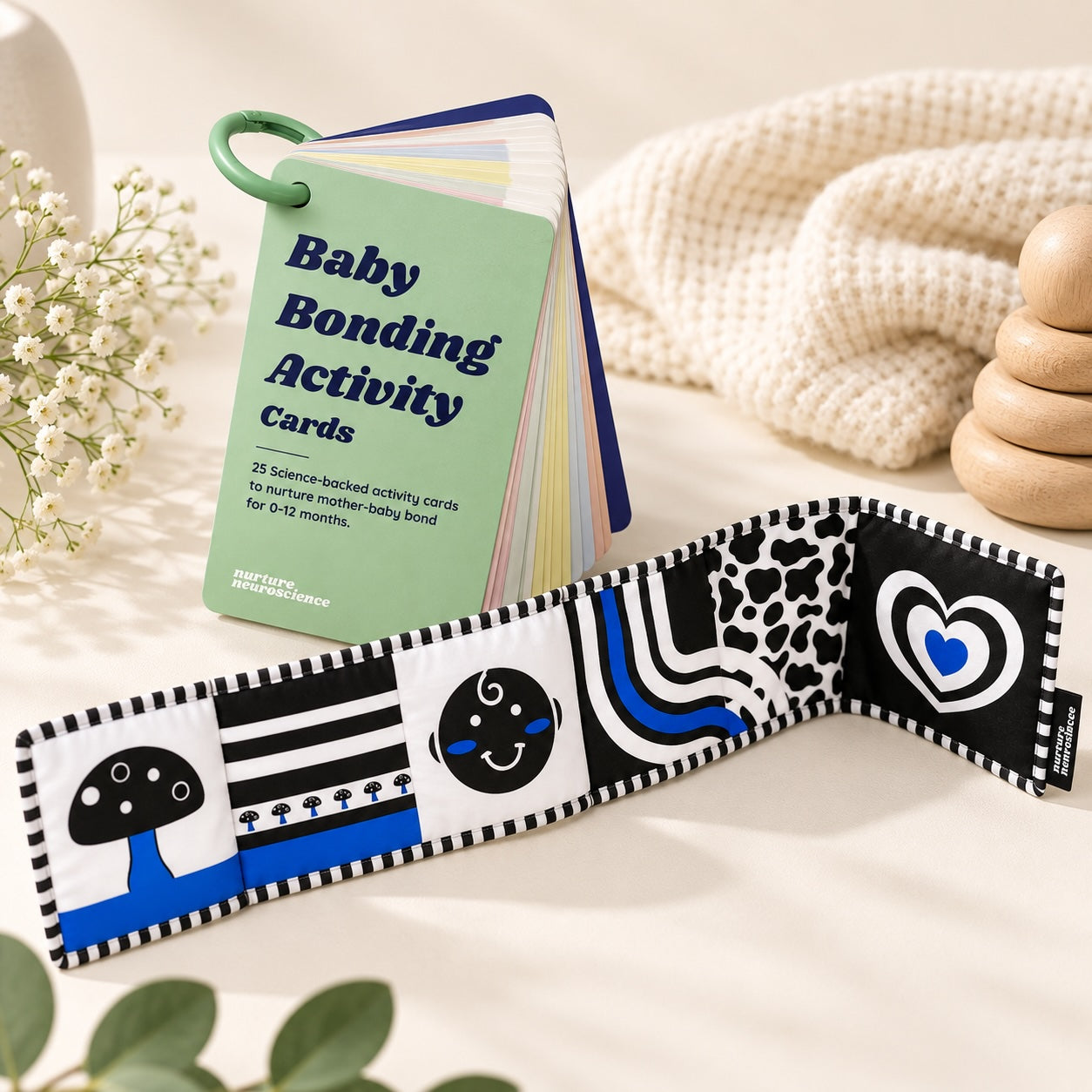
When energy is short, accept help with anything that isn’t holding or feeding your baby. Let someone else handle laundry so you can spend that time on a two-minute interaction instead. A brief, high-contrast card or toy can support this kind of moment. Raising Children Network recommends keeping newborn play short, close, and baby-led. Hold a card near your baby’s face, watch for engagement, and stop when they look away. The goal is shared attention, not a checklist of skills to test.
The Science Behind These Bonding Practices
Contingent responding, meaning a reply that arrives promptly and matches your baby’s cue, is the mechanism researchers keep coming back to. The PMC microanalysis of mother-infant face-to-face communication found that timing and contingency in early interactions predicted later attachment patterns more reliably than the content of the interaction itself. It’s less about what you do and more about how closely your response tracks your baby’s signal.
Public-health bodies echo this from a different angle. The Public Health Agency of Canada frames bonding as something built through talking, singing, cuddling, and responsive attention woven into daily routines, not a separate activity.
Dr. Greer Kirshenbaum, a neuroscientist and infant mental health expert who founded LovedFully, built the brand’s connection sets around this exact research: short, baby-led interactions that scaffold contingent responding without turning care into a performance.
A Note From LovedFully
Bonding grows through small, repeated moments of warmth, not through a single perfect day. If yours is slower to arrive, that’s common, and support helps. Screen-free tools exist to make those small moments easier to find inside real, tired, ordinary days.
— LovedFully
Simple Tools That Support Newborn Connection
Most bonding happens in seconds, not sessions, which is the focus of certain connection sets designed for this purpose. The New Baby Connection Set includes short activity cards designed to prompt a face-to-face vocal exchange or a moment of gentle touch during something you’re already doing, like a diaper change or a quiet stretch after a feed. Each card takes a minute or two, matching the “notice, respond, pause” loop rather than adding a new task to daily routines.
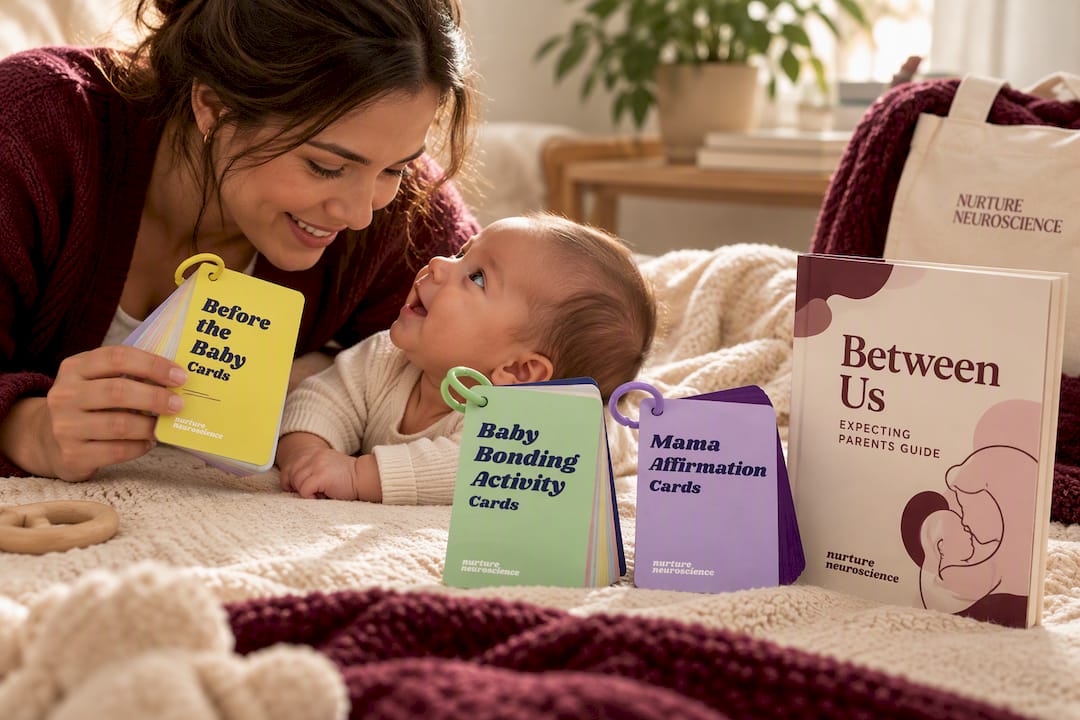
For expecting parents still preparing, the Parent-to-Be Connection Set offers conversation prompts that help both partners plan out caregiving roles before the baby arrives, which research ties to stronger partner bonding once the baby is home. The Between Us: Expecting Parents Guide works well as a shower gift or a shared prep tool for talking through expectations ahead of birth. None of these promise faster milestones. They’re built to make the ordinary, repeated moments of connection easier to notice and easier to reach for on the hard days. Browse the full collection of connection tools to find the set that fits where you are right now.
Sources
- Bonding with newborns: 0-3 months | Raising Children Network
- WHO Early essential newborn care — Questions and answers
- Canada
- Bonding with your newborn - MedlinePlus
- Microanalysis of mother-infant face-to-face communication and attachment outcomes (PMC)
FAQ
My Husband Isn’t Bonding With Our Newborn. What Can I Do to Help?
Give him his own protected caregiving routines, like the first morning diaper change or bedtime settling, rather than assigning him leftover tasks. Bonding often takes longer for partners without an early physical head start, and repeated one-on-one time closes that gap faster than reassurance alone.
How Important Is Bonding With a Newborn?
Bonding shapes how well your baby’s stress response, feeding, and sleep patterns develop in the early months. Responsive, contingent caregiving is linked to stronger attachment outcomes later, based on detailed studies of face-to-face communication.
How Do I Feel More Attached to My Baby?
Focus on short, repeated exchanges rather than waiting for one big emotional moment. Skin-to-skin holding, quiet talking during feeds, and pausing to watch your baby’s reactions all build attachment gradually, and tools like LovedFully’s New Baby Connection Set can make those windows easier to spot during a busy day.
What Are the Signs of Healthy Attachment in Babies?
A securely attaching baby increasingly turns toward a familiar voice, calms faster after being picked up by a known caregiver, and holds eye contact during alert stretches. These signs build gradually over the first months and beyond, not overnight.